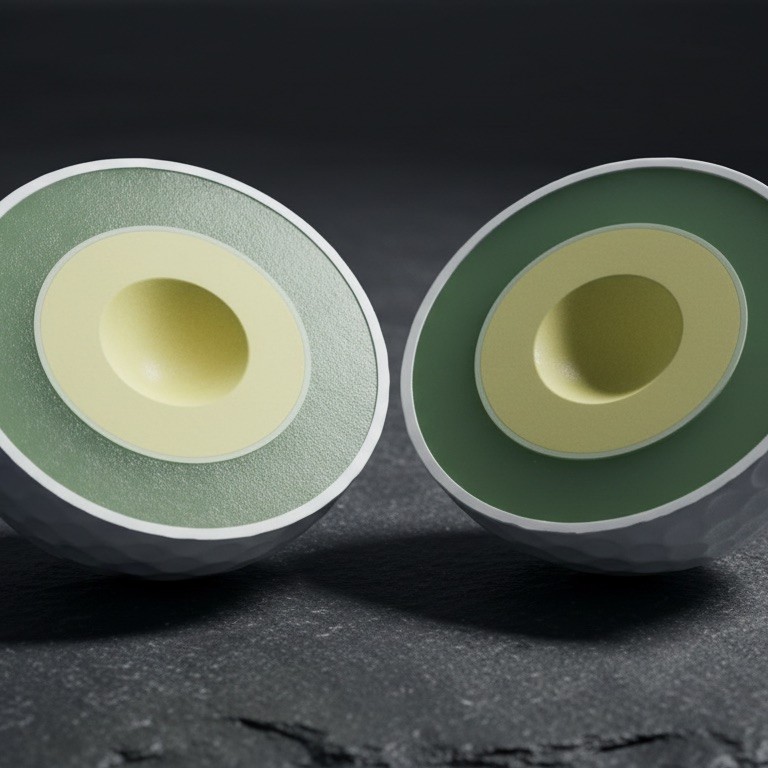
Two-piece, three-piece, five-piece: what golf ball layers do
Golf balls are sold by layer count, and the number keeps going up. TaylorMade sells a 5-piece ball. Callaway sells a 4-piece. The honest question is whether more layers produce better golf, and the answer depends entirely on how fast you swing.
What a layer is for
Every golf ball has at least two parts: a core that stores and returns energy, and a cover that meets the clubface.
The problem designers face is that a driver and a wedge ask for opposite things. The driver wants low spin so the ball carries. The wedge wants high spin so the ball stops. One material cannot do both well.
Layers solve that. By putting a mantle between the core and the cover, a designer can build a ball where the club compresses deeply at high speed, reaching the low-spin core, but only engages the outer layers at low speed, where the grippy cover dominates. The ball behaves differently depending on how hard you hit it.
That mechanism has a requirement. You have to hit hard enough to reach the inner layers.
The constructions
Two-piece. Core and cover. These balls are consistent, durable, and cheap. They spin less everywhere, which helps a slice off the tee and hurts a pitch shot into a firm green. Callaway Supersoft at 40 compression, Titleist TruFeel at 69, and Wilson Duo Soft+ at 37 are all 2-piece.
Three-piece. Core, mantle, cover. The first construction where driver and wedge behavior meaningfully separate. Most of the sensible mid-market lives here. Titleist Pro V1 at 87, Callaway Chrome Soft at 73, Srixon Z-Star at 90, and Kirkland Signature V3 at 75 are 3-piece.
Four-piece. Two mantle layers. Widens the separation further. Callaway Chrome Tour at 88 and Titleist Pro V1x at 97 sit here, both aimed at faster swings.
Five-piece. TaylorMade TP5 at 85 compression is the example most golfers know. The design intent is a progressive response across every club in the bag rather than two distinct modes.
Who benefits from more layers
Roughly, by driver carry distance:
- Under 200 yards. A 2-piece ball. Multi-layer construction is engineered to suppress spin you need more of, and you cannot compress deeply enough to reach the inner layers anyway.
- 200 to 230 yards. Two-piece or 3-piece. This is where personal preference on feel and greenside spin decides it.
- 230 to 260 yards. Three-piece. You generate enough speed for the layers to do their job.
- Over 260 yards. Three, four, or five-piece. Managing driver spin becomes a real concern and the extra layers address it.
The part the marketing skips
A 5-piece ball is not better than a 3-piece ball. It is more specialized. Specialized equipment helps a player whose game matches the specialization and does nothing for everyone else.
The same logic applies to blade irons, low-spin drivers, and 60-degree wedges. Nobody markets a product by saying most buyers will not benefit, so you have to apply that filter yourself.
Find your ball in about a minute
It uses driver carry distance rather than a guessed swing speed, then matches you against 67 balls across every construction from 2-piece to 5-piece.
Take the quiz →